In the following text some paragraphs are indented and separated with horizontal lines. These parts are drafts and notes that Adolf didn’t finish writing. Some of these notes were in German and those we have translated to English.
My Illustrated Autobiography
Writing one’s memoirs is a sure sign of getting old! Younger people neither have the interest nor the time to look back and review their life in the way you trace a stream back to its source, see the tributaries and currents that influenced it; how it sometimes would take a straight course like a river tamed between fortified banks; how it sometimes would force its way in narrow, winding apparent deviations when confronted by obstacles. Here, I’ll try to describe how people, events and experiences formed me, my thoughts, actions, and work. Most likely, I’ll keep embroidering the text from time to time. I’m still alive. And life is a work in progress.
The family trauma
I was born in Karlsbad (Karlovy Vary) in today’s Czech Republic on November 20, 1943. My family on both parents’ side was part of the German-speaking minority (Sudetendeutsche) who had been farming the gently mountainous region bordering Germany long before the area was part of the Austrian-Hungarian Empire. My parents, born in 1910, were Austrians, but without moving, turned Czechoslovakian citizens when, at the end of World War I, the Empire was shattered to be replaced by a number of independent republics. In 1939, Nazi Germany occupied and annexed the area, and we became German citizens. After WW II, in 1945, the area joined Czechoslovakia again, and in early 1946 three million Germans who had been living there were expelled and had to leave for Germany with a 20 kg luggage allowance per person. Our house, piano, furniture, grandfather’s farm and village pub, the family silver and porcelain collection which we tried to hide and everything else we had to leave behind when we were led into the cattle wagons that took us to Bavaria. I was two and a half years old and have no memories. But I’d hear stories about our deportation throughout my childhood.
What’s in a name
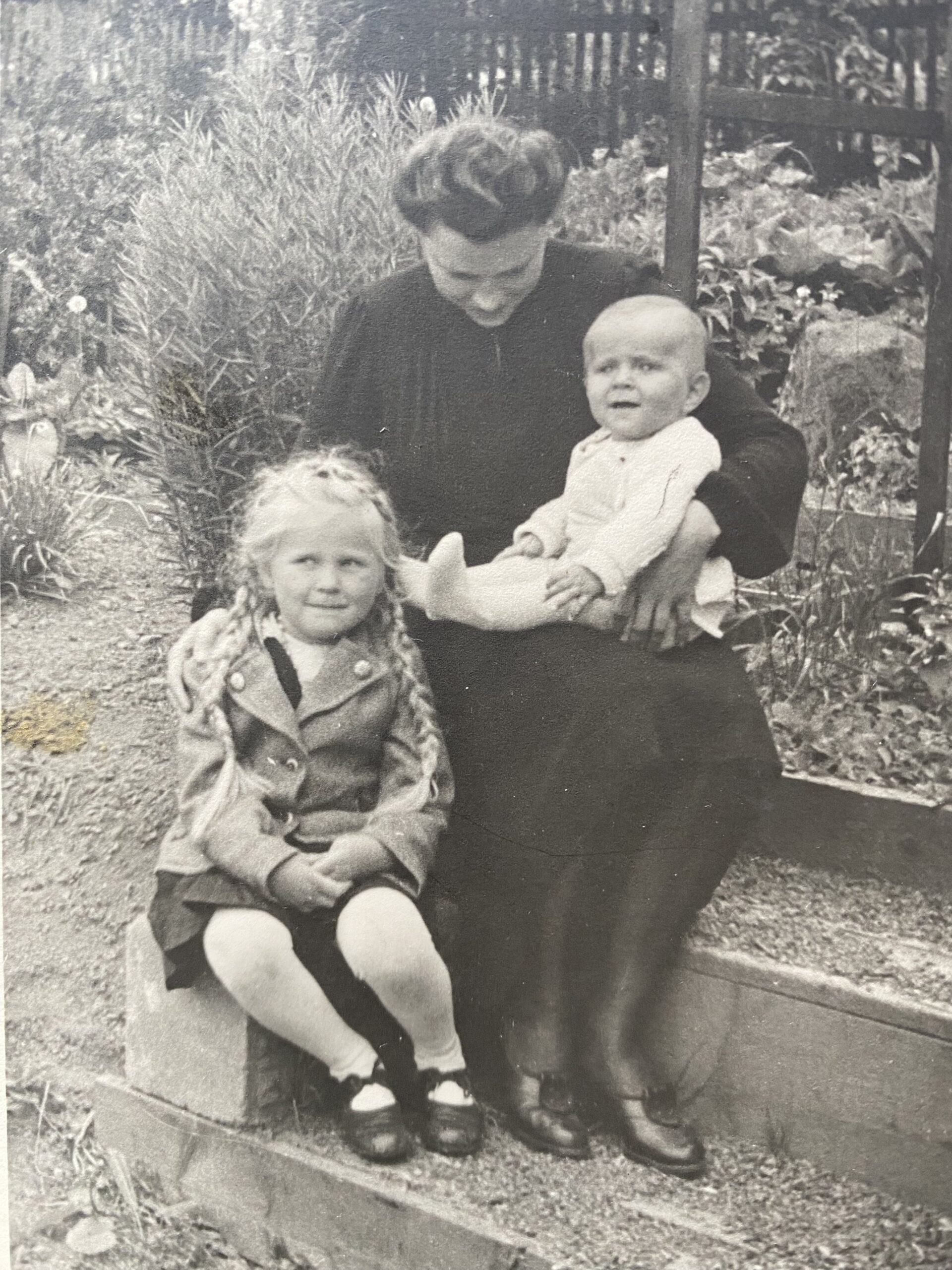
I grew up with my mother Maria Ratzka, a kindergarten teacher, and my four years older sister Linde in Manching, a small town north of Munich. My father, Adolf Ratzka, a middle school teacher, was killed in action during the war. At the front in Russia, when he learned of my pending arrival, he suggested “Dieter” as my first name in case of a boy. This is also the name on my birth certificate. But when my mother, soon after my birth, was informed of his death, she immediately called me “Adolf” to honor the memory of her beloved husband. I can’t say that I suffered from having the wrong name at the wrong time, from being teased about my name, particularly in Germany. It hasn’t been that often. Most people who have thoughts about my first name keep them for themselves. It would have been easy to change it. But my first name was too important to me; it was proof that my parents loved each other, that I was a truly desired and welcome child. This treasured knowledge I have been carrying with me as a protection throughout my life.
My mother tried to shape me. I was to follow my father’s footsteps. As long as I remember, she wanted me to become either a priest or a teacher of preferably the same subjects that my father had taught – German, Geography, and History. She did get me a mechanics [Meccano] construction kit when I was about 10 years old. That was the extent of it. Once – perhaps I was ten years old – I built a simple rubber band powered boat which she took from me explaining that she didn’t want me to become an engineer. Later on, she did not support and tried to ridicule my interest in building model glider airplanes. There was a paradox. I was supposed to emulate my father. But only in certain aspects. When I got interested in track and field sports, particularly in high jump and shot put, and joined a track-and-field club, she tried to ridicule me. It seemed that excelling in any non-academic discipline, in her eyes, was potentially dangerous to me. Sometimes, she’d put the fear in the words, “if you stick out, they’ll cut you down”. My father had been very ambitious which cost him his life, as my mother saw it. In that respect, I was not to follow him.
basteln segelfliegr, schiffe, kein geld für kopfhörer um radioempfänger zu bauen, mittenwald sparbuchse und bahnfahrt nach Ingolstadt zum meisterschaft, gymnasium skiwoche mit der klasses (es war wahrscheinlich nicht der geldmangel)
Although I never met my father he was present throughout my childhood. Mother would keep telling us children how he was, what he had said on this or that occasion, and what he would have said now. Often, she’d tell me “now you look just like Daddy”.
I was to get to know my father better and on my own terms much later, when I was already in my sixties, and Mother entrusted me with a cardboard box filled with letters and drawings from my father. During the war, at the front, from winter 1939/1940 until his death in October 1943, he sent her hundreds of letters, post cards, at least one a day, sometimes accompanied by his pencil drawings, water color sketches, occasionally picture postcards of cities or landmarks, with very few photos of himself. My mother managed to save over 300 items through the chaos of my family’s and three million other Germans’ expulsion. It took me over a decade to start reading them. I must have feared that the letters would put me in a depression. Many years of pent-up longing, disappointment, rage and sorrow would overwhelm me, that I’d be swallowed up by a black hole of depression.
At first, I found I got to know my father better and on my own terms when I worked my way through the letters he had written to my mother during the war. She gave them to me when I was around 60. But it took me nearly two decades before I was able to start reading them. Only after I went to therapy. Before that I was not ready, Father was still too painful, a raw and open sore, too ambivalent, on one hand, he had been raised up as an example on a pedestal high up out of reach with his qualities and achievements. In therapy, I came across my belief that my father spoke seven languages. I asked my mother to confirm and she assured me that he did speak fluent German and Czech, and through Czech he had some access to other Slavic languages such as Russian. But the story with seven languages I must have made up myself! Could it be that my father was my own construct? That there was no way for me to reach up to him because I had made sure that he was always too high? No wonder I had felt inferior to him for so long.
The letters were more objective, not influenced by my mother’s love and memory. I read the letters of an ambitious man, the war an avenue for advancement from his low, removed situation, new times were about to happen, he wanted to be part of that. Was he interested in politics? A belgian woman I met in Branden whose husband had been a Czech refugee, a social democrat, that fled to Stockholm where many others fled to, and where they had their own organization and newspaper during the war in exile, they were from the cities with industry and labor movement, not from the countryside where we were from.
In fact, during the last decade I have been wondering whether for me it perhaps turned out better that he did not get back from the war. My cousin’s father came back after years in a Russian prisoner of war camp. As far as I know, he did not talk much about what he had gone through there. He and my cousin Gunther must not have had it easy to get to know each other and build up a father son relationship. Gunther still seems critical of him.
My mother was ill prepared for the events that changed her life. The second of three daughters she grew up protected and cared for in a village where her father who had a large farm with many farmhands, worked as a butcher, and in addition, owned and ran the local pub. The family was respected, and my grandfather was elected mayor of the village a couple of times. Through the war, my mother first lost her husband after eight years of marriage, four of which my father served in the army. Then, came the loss of her home, her property, country, and social identity. As a single mother of two small children, she had to learn how to fend for herself in a new country, among people who did not welcome us, who were themselves poor after the long war, and had not much to share. During the initial period in Germany, we had to change quarters almost once a year, all three of us lived in one room with a tiny kitchen sharing the toilet with other people. My mother hardly ever left home in the evening. Once she did, and I still remember that my sister kept me awake fearing that mother would not return. Years later, I was told that she suffered from uncontrollable prolonged crying fits during these first years in Bavaria. Today, we might call it Post Traumatic Stress Disorder. I don’t remember any of this. I wonder why. It was probably too threatening a memory, better to be suppressed. But it didn’t do me much good I suppose, leaving a serious expression on my face often noted by others.
My sister Linde took responsibility for me, and for my mother when she had her depressive bouts, she must have noticed them more than I, at least on a conscious level, I don’t remember any of these bouts, I still do not have access to them, although now it wouldn’t threaten me as much as it must have then. Linde went to secondary school in nearby Ingolstadt, commuting by bus. Oberrealschule for girls with many nuns as teachers. She did well in school and was liked by her teachers. But a few years after I started high school, my mother took her out of school after she finished mittlere reife. Her teachers tried to convince her not to and implored Mother to let her stay. Mother’s argument was that she could not afford both of us going to secondary school. Linde was about 16 years old and Mother got her a job at a bank where she did not thrive and soon developed the first signs of skeletal symptoms that would follow her throughout her life. The irony is that our mother had told us how our father, after finishing graduate school, had to start work as an apprentice to the village blacksmith. But his grammar school teacher intervened, and managed to get him a scholarship at a teacher training school in Prague. Why she did not let Linde continue was never clear to me.
One bit of memory from my early childhood surfaced in therapy years later in Stockholm around 1980: early spring Sunday walk, Mother, Linde and I, with me having just recovered from a cold. We walked outside the village near the bombed out airfield where bomb craters still remained. Mother said, “I’ll jump down there when you no longer give me joy.” Forgotten. The memory surfaced in therapy 30 years later.
I wish I could ask somebody today about those years! But there isn’t anybody left. My mother passed away in 2006 at the age of 95. My sister left us in early December 2020 at the age of 81, unexpectedly – a terrible blow to the large family she left.
Gathering chamomile to earn money at the pharmacy. Searching downed airplane wrecks for precious metals to sell to the scrap metal dealer. Every contribution to family household was important
Whooping cough when school started, I stayed home for a couple of months, aunt Resi taught me reading. Books were rare.
A visit from Uncle Sepp, who came with a kick scooter [tretroller], I got a watch for confirmation. He invited me to visit in Augsburg by myself, when I was 10 or 12 years old. Did I travel by train by myself?
Holidays in Traunstein with Gunther. Forest, rocks, trees, wild raspberries, trains and coins on the rail, climbing the mountain with the two families, happiness, Chiemsee lake, the large body of water fascinated me, and a steamer ride. Now I am in Stockholm living close to a large lake and the sea. Swimming, twice in Traunstein and a couple of times in Munich at the Nordbad swimming pool. Pastry shop, the big city, playing cards with grandparents, cheating, Deutsches Museum (German Museum), Oma und Opa sprachen nie miteinander (Grandma and Grandpa never spoke with each other)? I heard decades later.
Nature in Manching, adventures at the river, fishing illegally.
My mother, like our family and the whole region, was Roman Catholic as was almost all of Bavaria at the time. She sought and got emotional support in her difficult times from the Church where she regularly went to a women’s group’s meetings who were engaged in social work. My sister sang in the church choir where she would later meet her husband. My “church career” started when a young chaplain rounded up pre-schoolers to teach them to play simple pieces on the recorder in church. In this way, I learned to read notes before letters. My later function during mass was to read the texts of the day’s liturgy, such as excerpts from the New Testament or from a Gospel. To learn how to present a text to a large gathering with the right volume, pace, phraseology, pauses, and intonation was useful for my public speaking many years later. I had to wear a long black sort of skirt, a black collar, and a long white shirt with long sleeves over it. Old ladies used to tell my mother that I’d make a handsome priest one day. I did not share such ambitions with her. I was getting interested in girls! Yes, I was religious but did not have a personal relationship to God. More important to me, as a displaced person, was probably to feel accepted in a larger community, to belong. I enjoyed church most after joining my former grammar school teachers who accompanied the church choir on their instruments during mass on Easter Sunday or other important church feasts. During one Christmas Eve’s midnight service I played the second violin of a Mozart mass. It was so cold outside and in the building that one of my violin’s strings burst when warming up but I managed to replace it and to join the orchestra before the end of the movement.
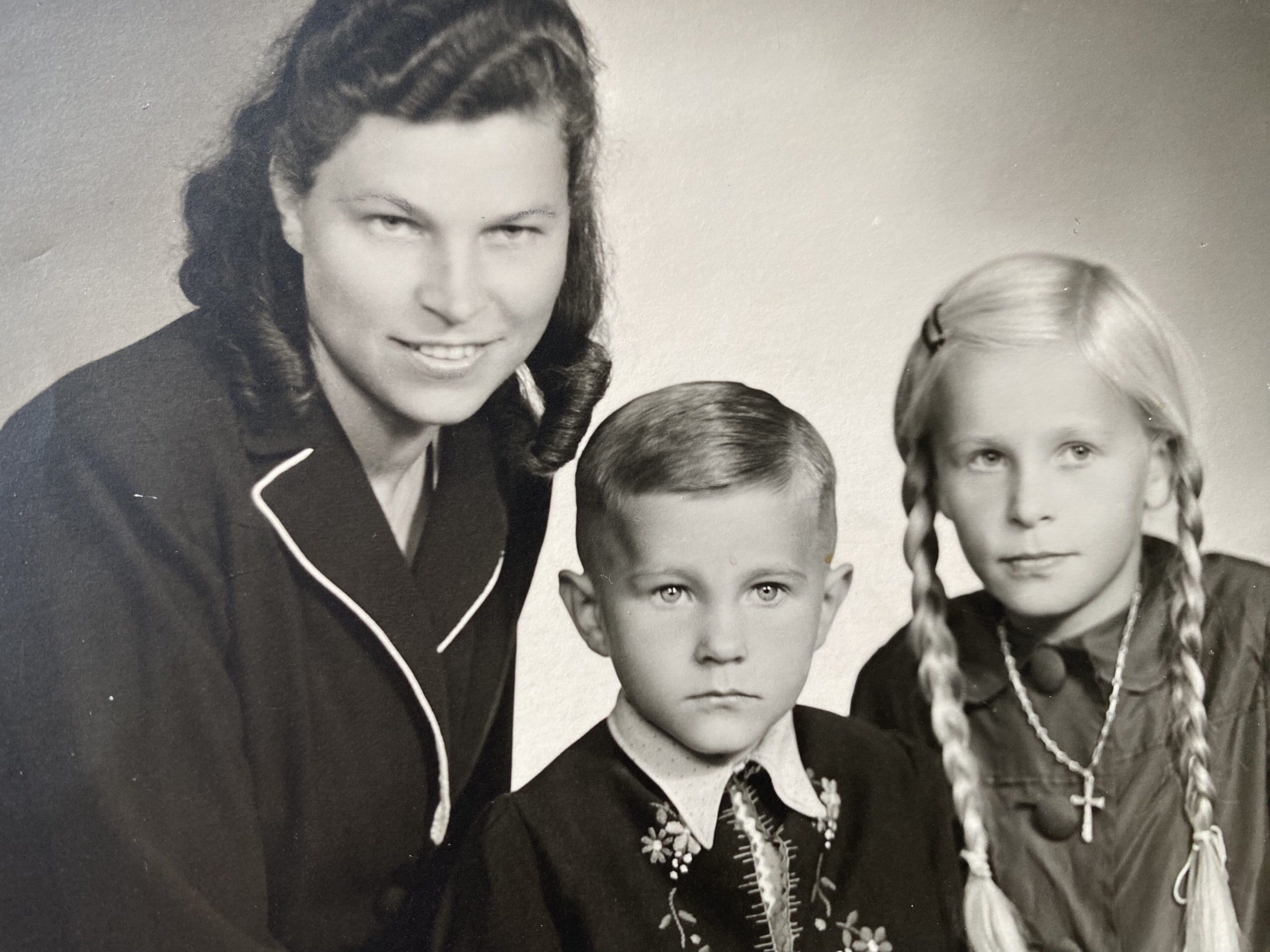
From living in the countryside with a mainly farming population and without much stimulation for a child I remember summers so hot and eventless that even the flies seemed to sleep in the middle of the day. Sunday was the highlight of the week. In this region, everybody would go to church. It was the best occasion for catching a glimpse of the girls seated in the pews on the left side of the church’s middle aisle, to check out the latest fashion in hairdos, and to meet up with friends after the service. That’s where everybody would gather. Smoking men in their dark suits in clumps on one side and women – the older ones often clad in dark scarves and several layers of dark, wide and long skirts – on the other side. Exotic, when I think back and not much different from the scenes in the movie “Zorba, the Greek” (1964) that I recently watched again. For Sunday lunch, Mother would cook meat – something we could afford only once a week. When the pork roast turned out greasy, Mother would feed us children afterward a spoonful of cognac to facilitate digestion.
Life could have been very tranquil if not boring, had it not been for some boys around my age. Everybody knew that we were displaced persons, we were different. I did not feel welcome. People would call me “dirty gypsy”. The neighborhood boys would wait for me after school to bully and beat me. Only at the age of eight or nine did I succeed in defending myself and climbing in the pecking order. My best memories take me back to the hours I spent playing by myself on the sandbank at a streamlet in the nearby woods. Nobody could see me. There was only me, the sound of the stream’s eddies, wavelets glistening in sunlight, the sand and pebbles I’d arrange into channels for small pieces of wood to float in, the various greens of the lush vegetation at the opposite river bank. Peace and tranquility, no thoughts of homework, or having to help my mother with housework. Over the years, I have learned to return to this place during difficult times. I would go back in time, cross the meadows until I’d reach the thick impenetrable thorny hedge that had an opening only known to me, and glide down the steep river bank to my haven.
I recall several persons with a disability who lived in Manching. A friend of mine had an aunt who had MS. I saw her only a few times – always in bed in a tiny dark room doing nothing, not even reading. The other image coming to mind is a woman in her 40s or 50s sitting in a wooden antique-looking wheelchair with a plaid blanket over her lap and legs, looking like one of the female saints in the village church, a volunteer community sister in full black uniform with an equally solemn and saintly demeanor pushing her wheelchair. A more interesting figure to me was a young man in his twenties or early thirties, dressed in a formal suit who walked with the help of two crutches under his arm pits by skillfully swinging both of his legs forward at the same time. There was a certain elegance about him. He hung around at the bus station with friends, smoking, and just shooting the breeze.
Primary and secondary education
After five years of primary school, I attended the nine-grade Secondary School (Humanistisches Gymnasium) in nearby Ingolstadt as a commuter. After a couple of years, as I became more secure in the academically tough environment, I got to like Latin and Classical Greek, German, and Biology. I liked Physical Education the most. The only teacher who is still alive and who I regularly visit, is – ironically for a secular person like me -, a member of the Catholic Redemptorist order, Father Fritz Kästner, who taught us not only Religion, Latin, and Classical Greek but, more importantly, humility, openness, and kindness through his own example.
After a few years in high school, I began to feel more comfortable with the teachers and among my class mates. I noticed that other students had similar backgrounds, were also refugees from the east, grew up without fathers and came from families that were not well off. That knowledge made me feel less ashamed of my low social status that I’d been reminded of so often in Manching where everybody knew each other. Ingolstadt, at that time, had a population of perhaps 50,000, and I enjoyed walking down the streets anonymously. I did well academically and performed above average which helped my low self-confidence and shyness. Mother had very high expectations of me – at least, she pushed me very hard. Your education, she used to say based on her experience with having lost her husband, house, and property, nobody can take away from you. As a result, I was ambitious and felt that I could not afford to fool around in school like the kids of wealthy parents. Some of them I’d help for pocket money with Latin which I enjoyed. It was very clear to me that I needed to be twice as good in school as boys whose fathers had come back from the war.
At each grade in high school, I felt more at ease, more confident, had more friends, enjoyed myself and the subjects we studied. I even think I was respected by my teachers and classmates. Twice I was elected speaker of my class (Klassensprecher).
Beginning at age 14, I used to work during Easter and Summer vacations. Partly to be away from home and experience new situations and people but also to earn my own money that I could spend as I wanted. My first summers, I spent on a large Celtic excavation site. Just outside Manching are the remains of the largest Celtic settlement north of the Alps that reached its peak of 5,000 to 10,000 inhabitants during the 2nd century BC. I assisted archeologists in documenting every layer of soil they removed from the site. Later vacations I spent on construction sites where I had to carry bricks, cement, and limestone – hard work for a 15-year old. But interesting. I learned a lot about how my fellow unskilled laborers looked at the world, at the recent Nazi past, their view of women, and at me who went to high school which to them meant that I aspired to become something “better” than them.
Among my high school classmates was Hans-Peter Meier with whom I am still in contact. We practiced violin together and played in the school orchestra. Hans-Peter was to become a lawyer and film maker. Decades later, we would travel and work together on a few projects. In seventh grade at high school, we made plans to hitchhike to Spain during the following summer vacation.
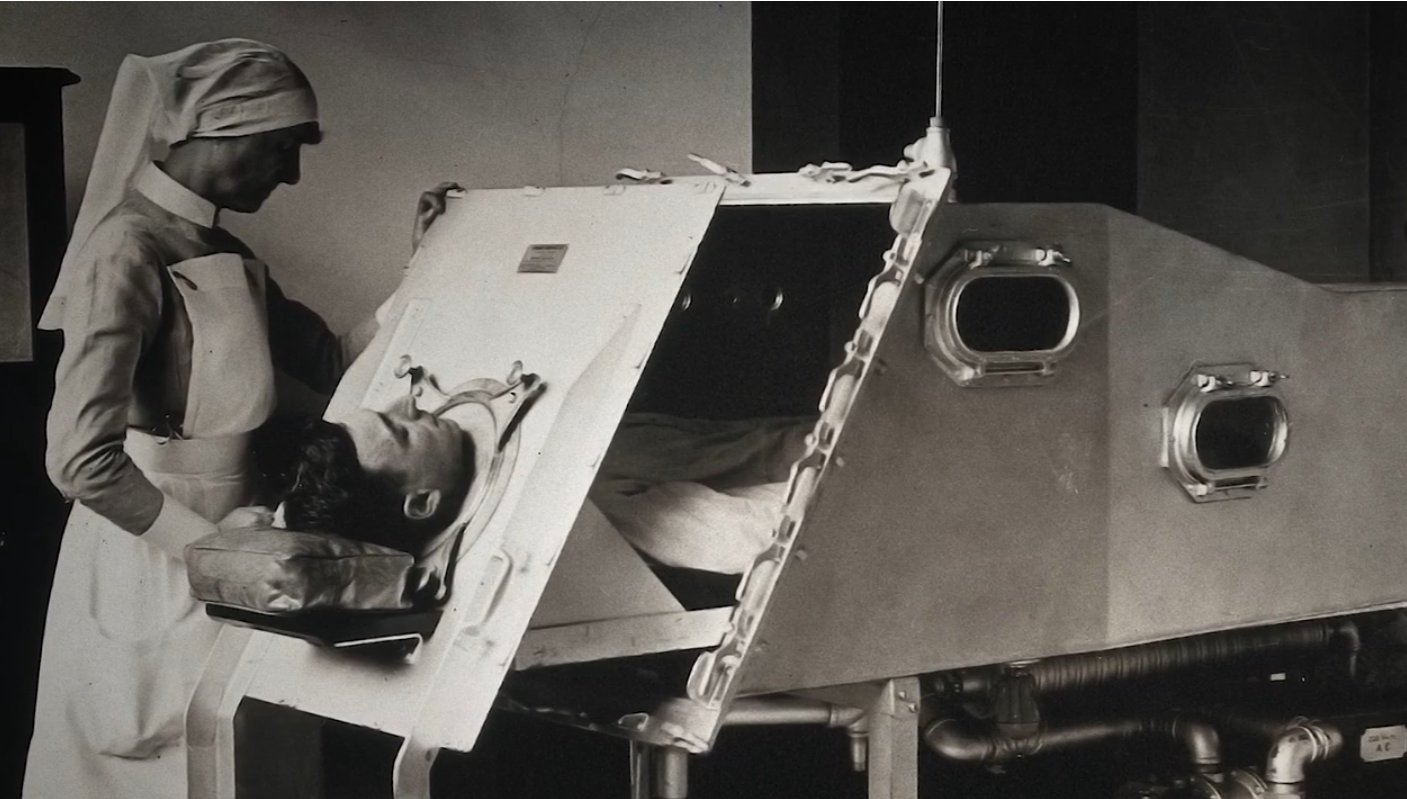
Patient in Friedrich-Baur-Institut, Munich
But the summer of 1961 turned out different. I had gotten a job and had assisted a team of surveyors for a couple of weeks who worked in the construction of an airfield for NATO forces near Manching. I needed money for my planned trip together with Hans-Peter when I contracted polio. Within a couple of days, I became completely immobile except for movement in some fingers, was unable to breathe on my own and had to be rushed by ambulance to a hospital in Munich. Stuck in an Iron Lung, and heavily sedated I was floating and day-dreaming in another reality seeking refuge from the catastrophe whose full extent would only slowly dawn on me. I had enjoyed my tall, fit and agile body that had made up a large part of my identity and had served me so well for high jumping, shot put and swimming, for dancing, walking on my hands, playing the violin. Now, I was reduced to a vegetable. In the following six months, my weight went from 80 to 43 kg due to loss of muscle tissue. I turned 18 in the Iron Lung.
An Iron Lung is basically a tube large enough to accommodate a person’s body. Only the head sticks out of this air-tight chamber. Bellows at the foot end put the chamber’s interior under pressure, alternating between positive and negative pressure at a predetermined frequency. Negative pressure sucks up the person’s abdomen and chest causing the patient to inhale. Exhalation takes place under positive pressure.
My mother left our house in Manching, stayed first with her sister’s family in Munich and later found a room elsewhere. She came every day to visit me. It was painful for us to see the other suffer. The medical staff did not allow my sister to visit me because she was pregnant with her first born. I was starved for contact, but at the same time, I didn’t want to face anybody outside the family. I was ashamed. My face had become greasy and was full of pimples. I didn’t have control over my bowels, and smells didn’t stay inside the Iron Lung. But worst of all were the faces of most visitors who didn’t know what to say. Neither did I have anything to say. It was torture for both parts and fewer and fewer friends came.
Trying to kill myself
When I began to realize that my body would never be the same as before, I wanted to die. There aren’t many ways to kill yourself when you are lying almost completely paralyzed in an Iron Lung, so I started to save up on the sleeping pills I was getting every evening, putting them into my cheeks. As a boy I had a hamster who did this with most food. I was hoping I could hoard enough pills so they’d kill me. But, unfortunately, the sleeping pills – just like the chocolate in my hamster’s cheeks – were dissolving way too fast in my mouth before they’d reach the desired effect.
Looking back, I smile at the traumatized kid I was at the time. At 17, what did I know about life and how could I have learned what life is about, what really matters! I had not lived long enough. Sure, the body is important. But there’s more to life. You don’t need the body to feel good about yourself. You still can feel connected, respected, you still can love and be loved. Today, I’d say that human life is about relationships. For relationships, you don’t need a perfect body.
I often think back to this episode when I read about assisted suicide. At the age of 17, I probably would have qualified for today’s assisted suicide programs in the Netherlands or Switzerland. My prognosis was hopeless enough. I’m sure many people who saw me then thought it would have been better for me if I had died. But what a waste it would have been! I would have missed the opportunities that later on would gradually open themselves, I would have missed the beauty of this world, the kind people I would meet, travelling to the interesting places I would be able to visit later, I would have missed delving into captivating subjects, would have missed challenging and rewarding work, deriving satisfaction from contributing in small ways to making the world a better place for disabled people. I would have missed friendship and love, my wife, our dear daughter!
Fighting for my life
After one month in the Iron Lung, the hospital staff encouraged me to learn how to breathe on my own again. That meant building up the muscles around my neck that lift up the thorax since I had no diaphragm or intercostal muscles left. For this, the staff would turn off the Iron Lung every day. First, for a minute, then, day by day, a few minutes more depending on my physical shape that day.
I had reached about 15 min breathing ability, when it happened. It was a Wednesday, a day when the other patients went for physical therapy in the indoor pool, and the staff was extremely busy. The young Austrian nurse turned the machine off and promised to return very soon. She didn’t.
I breathed and breathed and had already surpassed my previous record. Still, she had not come. I was getting panicky, as every breath became more tiresome. Long ago, I had pushed the alarm button in my hand. So had Alois, my roommate, in his Iron Lung. Alois and I tried to make noises with our mouths and lips. But no one could hear us. The room door was closed. I don’t remember what I was thinking, how clearly I could think given my lack of oxygen. Anyway, someone did eventually come to turn the machine on again. By that time, I was blue in the face, they told me, and had passed out.
Just a couple of weeks before, I was ready to kill myself. Two weeks later, I fought for my life until blue in the face. Here, I had the unique chance and I just let it pass, unused! I may not have had the thought then, but today, I believe that deep down I wanted to live after all, that life was worth living, too precious to be thrown away. I like to think that this experience was the turning point – or one of several turning points. That from then on, I was interested in living and making the best out of my situation
Harming a fly
I needed to stay and breathe in the Iron Lung for a total of three months. From this time I have more memories. This one I like the most.
It was getting towards the end of summer, the time when house flies come inside looking for warmth. They came into my hospital room climbing all over my face, tickling and irritating me. I could not scare them away since my arms were inside the Iron Lung. Besides, my arms were completely paralyzed anyway. One day, I had a plan. I waited until the fly would hover over my nose during the machine’s negative pressure cycle, and opened my mouth precisely at the optimum moment. My tormentor was helplessly sucked into my mouth. I squashed the fly with my tongue against the gums, and spit the lifeless body out with endless satisfaction. That was probably the most fun I had during the three months I spent in the Iron Lung.
Looking back at this incident, the lesson it taught me – surely not on a conscious level – may have been this: I may be almost completely paralyzed but I still can do something to improve my situation. Even if it is just a small thing. I am not completely helpless. I can carry out a plan. I can do things but have to do them differently. It might take more thinking; it might take me more time. But in the end, if I am stubborn enough, I can reach my goal. I am somebody to be taken seriously. Who can say, I can’t even harm a fly!
Religion
Catholicism had been an important part of our life in the small town in Bavaria where much of social life circled around the Church and its activities. I grew up in that faith and don’t recall ever questioning it.
In the first hospital ward in Munich I was admitted to, most nurses were nuns. In addition, my roommate Alois, in the Iron Lung next to me, a man in his early thirties, had been head of the Catholic Boy Scouts of Bavaria before he contracted polio. Apparently, this was an important position, since he was frequently consulted by many clergymen. They would ask Alois to put in a good word with Him for their earthly concerns. On one occasion, for example, new bells were needed in a village which required a large sum of money that the parish did not have. Alois’ disability was assumed to lend him connections with higher powers.
The assumption of a special link between us patients in the Iron Lung and God was confirmed by the nuns. The night nurse, for example, Sister Lauretana, repeated this message again and again. She worked every night without ever taking a day off. Old and very pale she shuffled through the room unsteadily. She’d tell me about the special grace that had been granted to me by allowing me to suffer already on earth. Others would have to do time in Purgatory after death, but I’d go straight up to Heaven immediately to sit on His right side. With these reassuring messages she’d comfort me while, at 6 o’clock in the morning, slapping a cold wet wash towel in my face and fumbling in my mouth with a toothbrush to get me ready for holy communion which the hospital priest would soon distribute among those who couldn’t come to mass.
Religion had become a powerful drug for me. I wanted to believe in miracles. Every evening, my roommate Alois and I would get a night cap of water that had been shipped from the fountain of Lourdes in France. Throughout my childhood, I had heard so many stories about miraculous recoveries. Catholicism knows many such accounts. For passing the stages of Canonization and becoming a full-fledged saint at least two verified miracles, among other things, are required. Some 10,000 Catholic saints are recognized which means at least 20,000 miracles are on record. So why shouldn’t a miracle happen to me?
My seemingly hopeless situation combined with this environment contributed to my religious fervor at the time. It didn’t last many years. The miracle I had waited so desperately for never happened. Or did it happen? As I think back today, in 2022, the transformation I was to undergo in the following 60 years seems truly miraculous!
In the pediatric ward, Schwabinger Krankenaus, Munich
After about half a year, I was moved to another hospital in Munich that had more experience with polio patients.
The other alternative for people like me, at the time, was spending the rest of my life in a residential institution. As it turned out, I had to stay five years in hospitals. Not because I was medically unstable but because of the lack of accessible housing and community-based support services. Today, 60 years later, this situation is still common in many countries. I spent most of the five years in a ward for children who needed mechanical ventilation. It was not an acute ward; it had the character of a warehousing facility. The treatment we got, for example, weekly physiotherapy, could have been provided on an outpatient basis elsewhere.
It was the worst period of my life. I no longer had use of my body, became dependent on others, had to swallow my pride and ask for help for just about everything. I lost most of the means for self-determination. As a patient, I was at the bottom of the hierarchy that controlled my body and daily life. Above all of us ruled an anonymous power over which not even the chief physician had much influence: the requirements for the smooth functioning of the ward dictated what everybody, staff, and patients, had to do, where, and when. The plan’s implementation demanded precise timing, and strict adherence to orders, leaving no room for individual circumstances. We all were interlocking parts of an intricate mechanism, like the huge clockwork in Charlie Chaplin’s movie Modern Times that swallows up the powerless individual passing it through its cogs.
Once, I was scheduled to have an X-ray taken and needed to empty my bowels the evening before, which I did. But at 3 am, the night nurse wakes me up and, without asking, shoves a suppository up my rectum. “I’m just following the orders in your journal,” she countered my protests. After half a century, I still remember the humiliation.
The staff on the ward was always busy. Without assistance from them, there wasn’t much I could do on my own except read, study with tutors to finish high school, listen to music, or watch TV. Above all, I could not leave the ward and the hospital compound alone. Somebody needed to push my wheelchair and help me with my jacket in wintertime. I would have loved to go to the movies but needed somebody to accompany me. I hardly knew anyone in Munich and could not meet people unless they came to me in the ward. I felt very isolated.
Worse yet, the few times I did leave the hospital compound, I felt self-conscious, shy, and uncomfortable, and I imagined that everybody stared at me. The longstanding adverse effects of institutionalization are well known.
At 18, I was the oldest in the polio ward for children on ventilators where I ended up. (One of the children, then perhaps three years old, was Uwe Frevert, who later become a leader in the German Selbstbestimmt Leben or Independent Living Movement. We still are in contact with each other.) We were medically stable but had nowhere to go for lack of wheelchair accessible housing and lack of assistance with the activities of daily living. It was the darkest period in my life and it instilled in me forever the horror of residential institutions in any form.
I was able to finish the remaining two years of high school with the help of private tutors who came to me in the hospital. I passed the final exams with some of the highest grades in all of Bavaria that year. Never before and after, I studied harder, more concentrated and focused. The tutors and the mental stimulation helped me greatly but the future seemed bleak. What could I do, where could I live? Who would want me?
During my five years in the hospital, I was surrounded by children and hardly met people of my age except for a few nursing students. I read much during these years but I had no one to discuss with and digest what I read. Books could not compensate for my lack of first-hand life experiences, of competing with friends and classmates academically and in sports, of going out with girls, meeting interesting adults who could be role models, working part-time and earning money of my own, going places on my own, travelling – how I longed to get out and see the world!
I hardly left the walled-in hospital compound. In the evenings, even in summer, I had to go to bed at 8 pm since only then there was enough staff to help me. I’d be lying on my rocking bed and listening through the open windows to the blackbirds singing in the park outside. Occasionally, I could hear young women laughing in the distance. My life had hardly begun and yet seemed to be finished already.
I only got to see some of beautiful Munich when nurses, in their free time, took me along in my pushchair to the movies or a concert, or my sister and my brother-in-law Eduard, Hans-Peter or my cousin Gunther took me for a ride in their car. On those occasions, we might drive into the beautiful countryside south of Munich. I still remember lakes surrounded by forests of brilliant autumn colors towered by the silhouette of the snow-capped alps in the background. Once every summer, the whole ward of some 30 children plus plenty of uniformed nurses would head to a popular tourist spot for the afternoon. We were lifted into army vehicles by volunteering uniformed troopers. When we descended on a beautifully located outdoor restaurant for lunch other patrons and staff were visibly shocked. I recall one owner in tears overwhelmed by the sight of so much concentrated misery. I hated these outings, wanted to distance myself from the rest. I didn’t want to be one of those pitiful cripples! It would take me years until I was ready to voluntarily associate with other disabled people
Once a week, we had physical therapy in an indoor pool. It took two persons to lift each of us out of the water although the pool had a lift designed to be operated by a single person. There were not enough staff to dry and cover us immediately after we’d left the pool, and we had to wait and shiver until all of us were out of the water. The nurses never used the lift saying it would take too much time. I suspected that they had not been instructed in how to use it. I was freezing and powerless, reminded of the meaning of “patient” in Latin – someone who waits and suffers.
The medical model meant it was better for me to be in the children’s ward rather than with the adults upstairs. There was hardly any contact, and there was oppression and struggle among the children when left to themselves: fights, physical abuse, and the terrible word “Hundskrüppel” (dog cripple).
I asked Ulrika (girlfriend at that time) not to visit anymore. I remember an anthroposophic youth group and a “Nachbar der kam und mich ins Konzert brachte” (neighbor who came and took me to a concert). This was something new—new ways of thinking I was starved for. Reading was not satisfying and was mainly for distraction—Graham Greene novels, and later, correspondence with him. It was a dark period, with the only light coming from my sister and Edi, who would take me for rides to get out. Sitting in the car, nobody would see my wheelchair; they took me for a normal person. Years later, when I saw the Freaks at UCLA, I felt threatened.
The PTs were nice to me. I remember a professor talking about a leather and steel corset for a female pelvic.
What kept me alive? Those first months in the 12-bed room, listening to the hit parade every Wednesday evening without headphones. I despised the hits, but I still remember some of the worst ones 60 years later because they were associated with my worst time. Once in a while, I had a short conversation with one of the young intern doctors or a student nurse. My mother’s visits were ambiguous; she brought me food I liked and books, but I could see her suffering, which made me suffer. There was also “Hape and Gunther, Berlin, Militärdienst, Einsamkeit” (Hape and Gunther, Berlin, military service, loneliness), and the distraction and dissatisfaction of wasting my time watching TV.
5 years of PTSS? (Post-Traumatic Stress Syndrome)
I was uncomfortable outside the hospital, constantly aware of people staring at me and very self-conscious about my appearance. I never entered a store or restaurant by myself. Somebody else would order and do the talking for me. Much later, I understood that the long-term institutionalization made me shy, robbed me of common age-adequate social skills, and made me feel different. It would take me years to recover, to learn to relax and enjoy the company of others.
At that time, no German university was prepared to accept students with my degree of disability. Mrs. Vollmar, director of the German March of Dimes (Pfennigparade e.V.) had taken a great personal interest in my situation. She found the tutors to teach and prepare me for the final exams of the then 9-year high school curriculum, and had convinced the Bavarian State to remunerate them. Mrs. Vollmar introduced me to the magazine Toomey J Gazette edited by Mrs. Gini Laurie, St. Louis, Missouri. Through the Gazette and my correspondence with Gini, I found role models in the form of people in my situation who were pursuing academic careers. I also learned of the existence of several US universities that had provisions for students with disabilities at the time. Among the persons that Gini’s magazine featured was Ed Roberts who attended the University of California, Berkeley while staying in his Iron Lung during the major part of the day. I wrote to him asking about the practical details of his life at the university. The program at Cowell Hospital Residence Program for Physically Disabled Students on campus which he had joined as one of the first residents, I learned, was financed by the California Department of Rehabilitation which automatically made out-of-state residents like me ineligible for admission. Little did I know at the time that Ed and his work would later play a very important role in my life.
Liberation
After much correspondence, the University of California, Los Angeles, UCLA provisionally accepted me for enrollment. The State of Bavaria department (today Zentrum Familie und Soziales, Hauptfürsorgestelle) that had financed my stay in the hospital and paid for my tutors agreed to bear my expenses while studying in the US – a historically unique arrangement that Mrs. Vollmar managed to mediate.
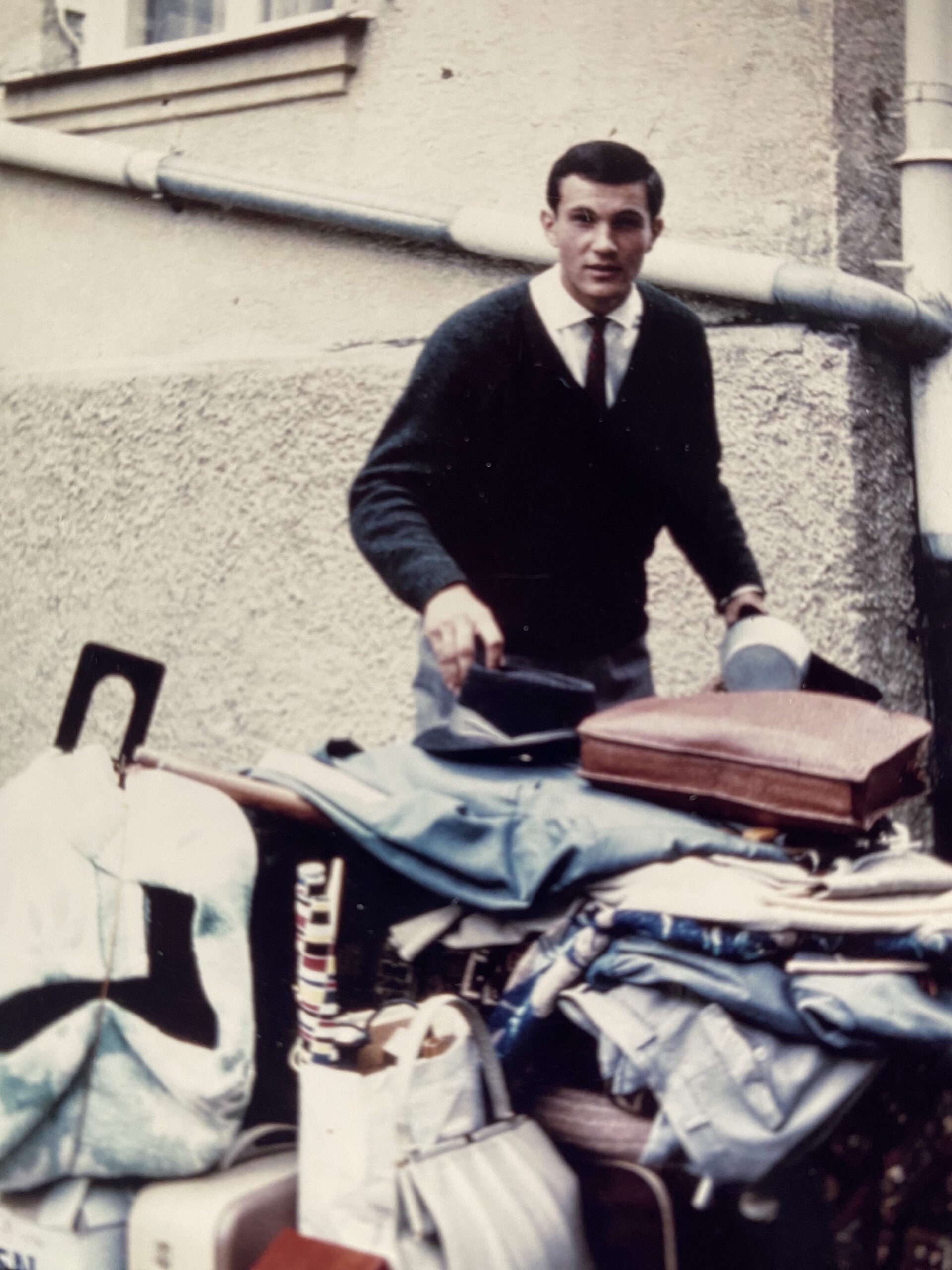
In 1966, aged 22, I left the hospital ward in Munich for a dormitory room in Los Angeles. My biological age may have been 22 years but my mental age wasn’t, as a consequence of my long stay on the children’s ward. On the trip, I was accompanied by my brother-in-law Eduard Mayr, a high school teacher who used his two weeks of Easter vacation for that purpose. After his return to his family and work in Bavaria, I’d be by myself with my electric wheelchair, my ventilator, and my considerable need of assistance with the activities of daily living in a country where I did not know anybody.
At that time, I did not grasp how difficult my leaving must have been for my mother – she who had been overprotective throughout my childhood! I first had to become a parent myself, many years later, to fully comprehend her courage and her suffering. I am still grateful to her for not trying to hold me back, for letting me leave. She must have understood the unique chance that my stay in California meant for me. She must have believed in my ability to find kind and helpful people on my way and to learn how to take care of myself. I’m sure that her evident trust in me helped me in proving her right.
On the trip from Munich to Los Angeles, Eduard and I stayed one night for rest in New York, at the then Goldwater Memorial Hospital on today’s Roosevelt Island. The person in the room on the rocking bed facing mine was Ira Holland who later became a dear friend and important role model by establishing Concepts of Independence in New York City.
The Beverly West Convalescent Home
Before I could move into a dormitory room on the UCLA campus, the university administration required me to stay somewhere else and get ready for moving into the dorm by recruiting so-called roommate attendants, fellow students who’d share my room and assist me with what I needed.
With the help of Ralph Dosch, Long Beach, one of the members of Gini Laurie’s Toomey J Gazette community, I found a place, the Beverly West Convalescent Home, where I would stay for two months. There, I soon discovered that “convalescent home” was a euphemism. It was neither a “home” nor did anybody recover from something. My fellow inmates were old and mainly immobile and had illnesses. I was the youngest by far.
I shared the room with Dr. Brown, a retired Mathematics professor who had an accident that left him in a coma. I don’t remember his face, only tubes. His wife came to see him every afternoon, slipping the orderly a tip to ensure he’d take good care of her husband. A month after I’d moved in, he quietly passed away. My other roommate was Mr. Hefferman, also an older gentleman who was quite mobile but preferred to stay in bed and listen to baseball games long into the night. Ever since I have hated watching baseball games. The only time he left his bed was to play bingo in the dining room. He was the champion and the cleaners couldn’t vacuum under his bed because there he piled up the Kleenex tissue boxes he’d won at bingo. The room was quite small for the three of us and there was no space between the beds for my wheelchair nor for a shelf for my few belongings.
During the day, there was constant traffic of wheelchairs with residents pushed by nurses in white uniforms between their rooms, the big communal areas, and the sun-drenched patio filled with permanent Muzak interrupted only by the cheerful voice of the public address system paging staff. Lining the walls in the hallways were rows of wheelchairs with residents staring at the back of the person ahead of them, motionless, expressionless, not doing anything. Sometimes at night, when Mr Hefferman’s sports caster happened to be quiet, I heard a woman down the hallway moaning “Martha” which made it difficult to sleep.
Every Sunday afternoon, visitors would fill the premises, most of them middle-aged couples with their children, many of them openly crying. Was it because of their bad conscience for leaving their parents in this place instead of taking them home? Many residents did not seem to need much assistance and it wasn’t obvious to me why they had to live there. Couldn’t their families have grandpa living in their house and hire someone to accompany him during the day? Money couldn’t have been an issue as the Beverly West was expensive. The staff had told me that many of the residents were wealthy after successful careers in Hollywood or in finance. With all that money, weren’t there any better alternatives to this nursing home in disguise?
I cannot say I suffered in the Beverly West Convalescent Home. I was looking forward to a bright future. After a couple of months, I’d move into the dormitory on campus to start the Summer Session. This would give me time to find a student with whom I’d share the dormitory room and who’d help me with everything I’d need. My stay at the Convalescent Home confirmed my experience at the Munich children’s ward: I didn’t thrive in an institution. They were not for me.
I used the time there to recruit my first personal assistant Bill Stallings, a fellow undergraduate at UCLA, with whom I would share a tiny room in the UCLA dorm for one year. He would be my only “roommate attendant” as this job was commonly referred to at the time. (It would take me years and painful experiences to understand that having only one assistant is not a healthy, sustainable solution.)
Assistants in the dormitory: Bill Stallings, Sjak Svendstorp, Mukul Ram, Nguyen Quan Than, Tim La France, Mark Kitzman, Jim Santi.
Jim Santi was an assistant who was born in Colorado to a family of migrant farmworkers of Mexican origin. He worked as a lab assistant at the university medical complex. He was a small guy, a bit older than me, sober, and often dressed in a black suit. He was soft-spoken but open to talking about himself—how he didn’t fit in, and how his family thought he was different. He had different visions for his life; he wasn’t interested in going out, drinking, or women. Instead, he read history, studied, and was interested in the history of his people. He lived off-campus in an apartment and commuted by bus. Once he told me how he was sitting on a bus and was observed by a police officer in a car who watched him through the window. At the bus station where he got off, the police car stopped too. The officer made Jim lean over the car and frisked him in front of everybody on the street. He felt very humiliated, and no explanation was given. Several years later, after he had worked for me, he had moved up north to San José. He had studied law and went into private law practice, working for Chicanos. I visited him. He had changed—he was self-assured and had found his place. It was a very impressive transformation that I was privileged to witness.
I remember a Colombian guy in 1970, a California kid who shot dice in the dorm elevator.
Friends in the dorm included Dan Lowitz, a quiet, subdued, very kind, and considerate psychology major. He had served in Vietnam but did not talk about it, except to say he had been stationed in logistics, not at the front. I didn’t realize at the time, but from later experiences with myself and other friends, I concluded that he was depressed. His symptoms included a lack of enthusiasm and indecision about even small things, like whether he would come along to the beach. He was a bit older than me.
Our dorm, Dykstra Hall, consisted of 10 floors with perhaps 40 rooms on each floor, each for two students. The upper floors were occupied by women. The rooms were left and right along the long hallway, rooms opposite each other, in a military barracks or prison style. In the middle of the hallway on each floor, there was a lounge with a large window front and sliding doors out to a wide balcony, overlooking Gayley Avenue, which wound up the hill. Along Gayley were mainly fraternities. A couple of times during final exam season, when most people were studying almost around the clock and many of us got quite agitated and needed a distraction, like driving downtown LA in the middle of the night to get dozens of hamburgers from a place that was in fashion, we’d go up to a higher floor to “bomb” the fraternity buildings with water balloons. We’d use medical-grade rubber hoses to catapult the water-filled balloons from our height way across Gayley into the yard, driveway, or entrances of the fraternity row.
Fraternities attracted strange people. Some of them were outright racist and had signs over their doors like “no dagos, no kikes,” which I found out meant no Jews, Hispanics, etc. That was, of course, against the official policy of the university, but since the fraternities were privately owned and not located on university property, they continued.
The lounge had easy chairs and sofas. Sometimes on weekends, the graduate student who was in charge of the floor would organize events, often old black-and-white war movies from the WWII air battles in the Pacific. I remember how upset I was about [a particular event or scene].
Rafiollah Gabai, Anas, Bob Gorski.
Friends: NN Roessner, Martha and Fred Wallner, Benjamin Bobo, Doug Martin, José Serrano (Venezuela), Arthur Young, Monika Linke (Whittaker), Schwabs, Fritz Busse.
Kurt Simon, a filmmaker, correspondent for ZDF (German TV?), and a real estate investor in Venice, was the chair of the Venice Property Owners Association. He had a conflict with a black trainee in Cuba.
Professor Knickerbocker and his dog, an electric cable leash, Mozart and a harmonica. He would go to Venice Beach and carry his dog, protecting Vienna.
The State of Bavaria paid my personal assistance. Each month, I received a check with the amount that covered my average number of assistance hours per month multiplied by the hourly wage that my assistants and I had agreed upon. I paid an hourly wage that was slightly above what students would typically earn for work on campus, for example, in the libraries or cafeterias. I estimated how many hours of daily assistance I would require for my personal needs such as bathing, going to the toilet, getting dressed, etc. Cleaning or meal preparation was not included as we lived in a dormitory where the monthly rent included cleaning, clean bedsheets, and all our meals in the common dining hall. My estimate was not questioned by my case manager at the [State of Bavaria]. In this way, I had what we call today true personal assistance, complete control over decisions such as who is to work for me, at what times, where, with what tasks, and how to do the work. I was the boss and could only blame myself when things did not work out.
I employed fellow students like Bill and Mark and many others as roommate attendants (personal assistants) over the years. The lessons I learned from making mistakes in recruiting and directing personal assistants and the resulting impact on my quality of life was to set me up for life-long work for de-institutionalization and personal assistance.
My roommate attendants were about my own age which contributed to a congenial atmosphere. Some of this mood can be felt watching my assistant Mark Kitzman and I in the footage for a documentary about children and youth with disabilities that director Werner Herzog and his team including my friend Hans-Peter filmed in Los Angeles in 1970.
Video clip of documentary Behinderte Zukunft by Werner Herzog, 1970.
Life as a student at a huge international university with its countless opportunities was overwhelming. From the confinement of the hospital ward in Munich, from dependence on its staff who controlled my movements, and my painful social isolation I had been catapulted into a different universe where I was free to go to bed when I wanted, where I was the boss of my personal assistants and not the object of the hospital ward’s professional interventions. I was among people of my own age, I met and became friends with people from all over the world. I had to learn how to study, read a lot of books, constantly digest mind-boggling new concepts, and write term papers and exams. Finally, I got something to set my teeth in, finally I felt challenged.
Coming from a limited background, I was confronted with its social, cultural, and intellectual opportunities with international artists, its challenges, friends of my age and similar interests from many countries, experiencing the California of the 1960s and 70s where everything began: flower power, student activism, demonstrations with the National Guard and tear gas on campus in 1968, the Free Speech Movement, hippie culture and music, New Age, anti-war protests, the civil rights movements of women and ethnic minorities, the beauty of California’s beaches, its national parks and countryside, and trips to Mexico with my converted step van that I could drive myself – all that compensated my starved brain for the lack of stimulation I suffered during the five years in the children’s ward.
Guadalajara
In the summer of 1968. I did not stay in the dorm to study during summer session. During the Spring term, one of my courses had been Spanish 1. I found a place in Guadalajara that offered accommodations including food and [went to Mexico.]
A performer: Benny Goodman, Dietrich Fischer-Dieskau, Zubin Mehta, Maharishi, Timothy Leary of LSD fame, and Richard Alpert (then already Baba Ram Dass).
I remember a car, the Santa Monica Mountains, Venice Beach, skipping classes, and changing sidewalks when I saw a disabled person approaching me. There was no identification with “freaks”, damaged by the years in the hospital.
At UCLA, I made friends with Doug A. Martin and Robert Gorski who both were to become eminent disability leaders in California and nationwide. We dreamed of organizing students with disabilities, demanding better accommodations from the administration, following the example of what we heard was happening at UC Berkeley, starting around 1970.
My ventilator equipment and help with its maintenance I received from the March of Dimes.
Gini was to later connect me with many more interesting and colorful people with disabilities of my age, such as Judy Heumann, Ira Holland, Audrey King, and numerous others. Her biannual conferences in Chicago and St. Louis from 1981 to 1989 were transformative. She became almost a mother figure to me, a very important hub for me, connecting me.. [with the larger disability rights movement]
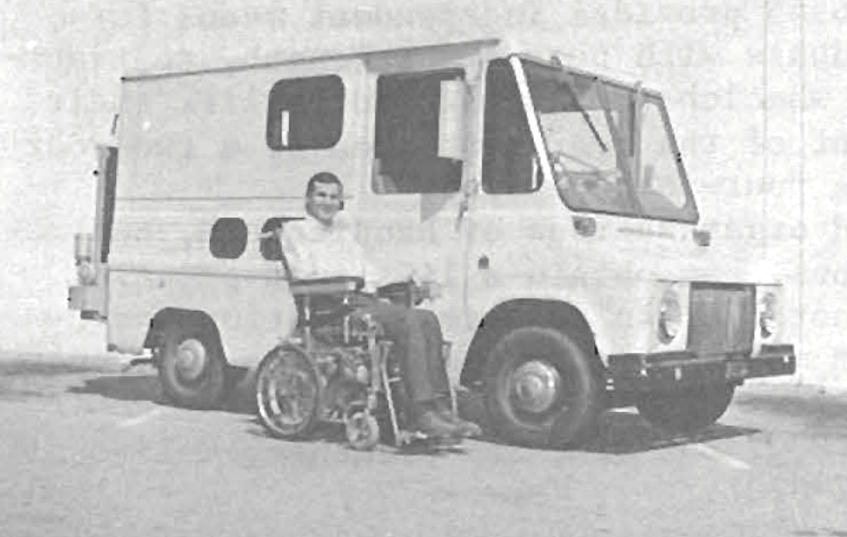 My car.
Through Mrs. Margarete Vollmar, and Mrs. Gini Laurie, editor of the Toomey J Gazette, St. Louis Missouri. Adolf Ratzka, “Odyssey of a Bavarian Scholar”, Toomey J Gazette, Vol 9, No 1, 1966 pp. 46-47
My Mecca
After more than seven years of living, studying and working in L.A. I had applied for a research grant from the German government that would enable me to spend sufficient time in Stockholm for field work for my dissertation. Before leaving for Europe, I wanted to visit Ed Roberts and his group in Berkeley. On May 17, 1973, a few weeks before leaving for Europe for what I thought would be one year, I flew up to the Bay Area, by myself, to visit Berkeley. I did not take an assistant along nor any luggage. Not even my ventilator that I needed at night for sleeping, a so-called chest shell, an unwieldy plastic device that covered my chest and abdomen. Air was pumped into it through a long hose from a suitcase-large machine – not precisely travelling light!. I’d just be gone for the day. I had made arrangements beforehand with Ed who’d promised that somebody would pick me up at the airport. When nobody showed up I called the center and, finally, a pony-tailed conscientious objector with his German shepherd working for the center came in a greenish Ford Econoline van with a tailgate lift for wheelchair users to drive me to Berkeley. The PDSP, Physically Disabled Student Program was located in a two-story former apartment house where a huge steep wooden outdoor ramp wrapped around two sides of the building was leading up to the second floor. On top of the ramp was a sunny spacious landing overlooking a bamboo grove.
Ed wasn’t there, he’d gone to Sacramento to meet some politicians about new funding. So I missed him this time. His mother, Zona Roberts, an attractive woman in her fifties with short dark hair in a wide blue flower printed dress worked that day as a volunteer, cooking lunch for everybody who happened to be in the office whether staff, client, or visitor like me. We had Sweet and Sour Pork that day. Over the years, it became a tradition between Zona and I that I’d remind her of what she’d cooked for dinner last time. The hallways of the charmingly informal office were painted in wide stripes in the colors of the rainbow extending over walls and ceilings. The rooms smelled a mixture of cedar wood and mold. The office was milling with busy people whizzing around in electric wheelchairs. There was bearded giant John Hessler, his 6’5” frame too large for his E&J power chair, showing me around and explaining the function of the office. As PDSP Director he was an Assistant Dean of UC Berkeley but he wore no tie. Nobody did. His 13 person staff’s job was to make sure that students with disabilities had equal opportunities while attending UC Berkeley. That included classes in accessible lecture rooms, reasonable accommodations at exams, wheelchair accessible student housing near campus, reading services for the sight-impaired, emergency repairs of electric wheelchairs, etc. Soon, PDSP would expand into the Berkeley community in the form of the Center for Independent Living on Telegraph Avenue and serve former disabled students who didn’t want to leave Berkeley and go back to some boring place in the Midwest or wherever they had come from. Many people who’d heard about Berkeley had moved to this wondrous place where so much was going on. What impressed me most was the fact that both PDSP and the CIL were started, run and controlled by disabled people, the Rolling Quads and their followers. These were truly places of disabled people, by disabled people, for disabled people. (Theodore Parker, preacher and social reformer in a 1850 speech to a New England Anti-Slavery Convention called government of the people, by the people, for the people “the idea of Freedom”.)
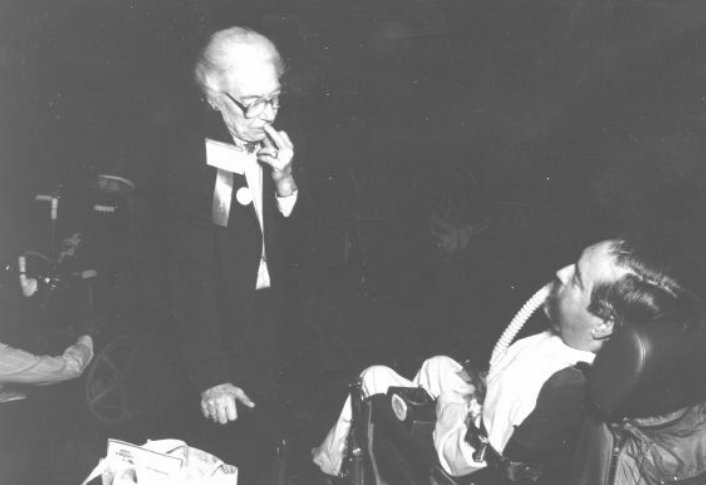
I made a promise to myself to come back to Berkeley, the “Mecca of the Independent Living and Disability Rights Movement”. I would return many times up into the 1990s. The first return was in winter 1975. By that time, I had been living in Sweden for two years and had to be in L.A. to present the outline of my Ph.D. dissertation to UCLA. I still had my adapted van waiting for me in L.A. that only I could drive. I drove from L.A. on Interstate 5 to Berkeley with Gary, an assistant who had worked for me while studying at UCLA years before. He was available for a couple of days only and I had to find somebody else to be my assistant in Berkeley, mainly for helping me to bed and getting me up in the morning including washing, toileting, dressing. The first weekend, I had no place to stay and Ed put me up in his “green house” (for its outside paint job) on Ward Street where he lived with Zona and his brother Randy. I slept on the couch in the living room in the company of Sam, an old dog who used to fart a lot and shit on the carpet. Ed spent many hours in his Iron Lung where he did most of his telephone work. He could dial and pick up the phone with a switch next to his mouth. We could sit around his Iron Lung in the evening and pass a joint, and some Californian legislator would call Ed to run a proposal by him. Ed was recognized as a leader of many young disabled activists who were highly political, outspoken and whom the media loved. He had made a name for himself by such work as pushing the campus administration to phase out the Cowell Memorial Hospital Wing where many quadriplegic students were initially housed and to open up the dorms and other accommodations in the community for them. Ed also had led campaigns for making Berkeley more accessible by installing curb cuts with the help of volunteers up and down Telegraph and Shattuck Avenue. As legend has it, they poured buckets of concrete in the street, in the dark of night, to create elegant ramps – curb cuts as they called them – at strategic intersections. Using the ramps, you could walk across the street in your chair without having to interrupt your conversation with a companion. Soon, the City administration realized they had no choice but to build such ramps at all intersections. They are very popular with everybody on wheels including skateboard kids. Ed was a brilliant and charismatic speaker who’d impress any audience. In 1976, Governor Brown appointed him Director of the California Department of Vocational Rehabilitation, the very agency that refused him services due to his extensive disability a decade before.
In 1975, I had a whole month to spend in Berkeley. Ed helped me find another couch at Cathy Caulfield’s place next door to John Hessler’s apartment. Cathy had been the first woman at the Cowell Memorial Hospital Wing and of the Rolling Quads. John, who’d been the second Cowell resident after Ed, was an interesting fellow. He had a degree in French literature, had spent a year in Paris studying at Sorbonne and had camped extensively in France in a VW bus that – as the legend goes – was too short for his legs that stuck out of the back of the bus. He and Ed had been members of the Rolling Quads, residents of Cowell Memorial Hospital Wing on campus who are credited with starting the Independent Living Movement by working with the University and, later, with the administrations of Berkeley, Oakland and other Bay Area cities to prepare them for the inclusion of persons with extensive disabilities in the community through adapted housing, infrastructure, public transportation and social services. Ed and John, as I found later when I’d become friends with both, complemented each other and formed a very powerful team. While Ed was good-looking, well-spoken and charismatic, John was down-to-earth, analytic and delivered the goods. He’d flesh out the details with the bureaucrats after Ed had presented an idea and convinced the politicians. John who had a C 5-6 spinal cord lesion had trained himself to require very little assistance. In his bedroom, there was a giant special-made wooden frame above his huge bed. The frame, which he had designed himself, sported slings and levers that enabled him to transfer between bed and wheelchair. John was known for his casserole cooking and ended up on the cover of Gini Laurie’s Rehabilitation Gazette in a photo that showed him cooking.
For Christmas, I was invited for dinner at the Green House. I parked my van along the curb in front of the house and Zona and Randy saw me arrive through the living room’s lovely bay window. I went to the back of the house where the wooden ramp into the house was. It had been raining in the afternoon and the ramp was slippery. At one point halfway up the ramp, I backed the chair off a bit but jerked the joystick forward again which made the front of my E&J power chair rise. At that point, Randy opened the backdoor, immediately saw my situation, grabbed my foot pedals that were already high up in the air, and pulled me down on my four wheels again. Had it not been for the weight of the gallon of Gallo red wine on my knees, who knows, I might have tipped back before Randy had a chance to stop my chair.
One evening that winter in Berkeley on a walk through the neighborhood together with Peter, a British friend who worked mornings and evenings as assistant for me, we passed the headquarters of the Bay Area Anarchists, easily recognizable by the huge flashing white-blue neon light roof top sign “Smash the State”. As we passed the building, a couple of young men approached us asking for help in turning over the police car at the corner. We declined politely knowing that as non-citizens – my Green Card would not have helped – we would be taken into custody if caught in the act. Years later, I participated in San Francisco in a demonstration with thousands of people urging the University of California to sell off its pension fund holdings in South African companies. That was long before Nelson Mandela became his country’s president. Most of the highly politically aware Berkeley disability community was there. Some wheelchair riders were chaining themselves to the pension fund’s building. Michael Winter, Director of the Center for Independent Living on Telegraph Avenue in Berkeley had already forewarned the police headquarters in San Francisco of the large number of wheelchair using demonstrators who might require wheelchair accessible transport and custody facilities.
I was tempted to join them but remembered that without citizenship I could be deported. Apartheid and discrimination of any group were important targets for the Berkeley disability community. As Martin Luther King Jr. said, “injustice anywhere is a threat to justice everywhere”.
I also met Hale Zukas who communicates by pointing his “woodpecker” stick at a table of letters on his wheelchair’s lapboard. The stick is mounted on the front of the home-made leather helmet-like contraption he has on his head. The story goes that he’s had the same gear since the 1950’s. With the stick, he’d also type his disability policy papers, analyses, letters to the editor. Most of his work is now conserved in the archives of the UC Berkeley Library. Hale drives his electric wheelchair with his head via the stick. He has degrees from Berkeley in Mathematics and Russian – allegedly for being able to read Russian Marxist writers in the original – and is credited, among many other achievements in the area of disability rights, with having been one of the most ardent and effective advocates for making the Bay Area Rapid Transit (BART) wheelchair accessible – a victory that paved the way for accessible mass transit systems in other US cities. When I first met him, he was accompanied by a stunningly beautiful personal assistant with Jewish Afro hair. Hale is widely known and recognized as a real character. To save typing strokes he developed his own economical writing style leaving out letters in a word – mainly vowels – that are not essential for deciphering it.
I would meet people like Kitty Cone who later was the organizer of the 1977 occupation of the SF Federal Building by 150 disabled people for 28 days (featured in the 2021 Oscar nominated documentary Crip Camp) that resulted in signing the regulations of Section 504 of the Rehabilitation Act of 1973. In 1981, Kitty, a wheelchair user, and her blind partner temporarily moved to Mexico to be able to adopt her son Jorge there. I spent time with Brian Ryan, a British draftsman of my age using a wheelchair who had moved from the UK to Berkeley where he lived with his wife in a neat house with a hot tub in the backyard. Once, I was sitting with him and two nubile young ladies in the hot tub. Ahh, those were the days! During that visit, in November 1981, I participated in the “All Beings March” in the Golden State Park across the Bay in San Francisco. I remember different bands, for example, Canned Heat and recall Jerry Garcia of Grateful Dead fame jumping around in a white rabbit suit.
Judy Heumann wasn’t living in Berkeley until the middle 1970’s. I met her in 1981, at Gini Laurie’s first conference in Chicago and was immediately taken by her. After the conference, I followed her to Berkeley and slept a couple of weeks on the couch in her living room. Judy had been invited by Ed to join him at the Center for Independent Living in Berkeley. By that time, she had become a national figure thanks to her civil rights organization Disabled in Action and her successful lawsuit against the City of New York for refusing her a teaching position because of her disability despite her teaching credentials. At the CIL Berkeley, she started up departments that became successful and self-supporting such as the Disability Rights Defense Fund, DRDF, a legal advocacy center that became a model for many similar outfits. Ed, Judy, and Joan Leon founded the World Institute on Disability in Berkeley after Ed left the Department of Vocational Rehab. In 1985, they invited me over for a WID Fellowship that enabled me to work there for three months. Doro Riedel and I – before we became a couple the year later – stayed in Judy’s house during these months. Over the years – Judy and I are still in frequent contact – we have met and worked together many times, in many places. We not only talk work but also personal things. I’m proud to be one of many of her friends all over the world whom she calls or texts, whose spouses’ and children’s names she remembers. Through her activism, her national and international role as organizer and spokeswoman of the Independent Living and Disability Rights Movement, her work in the Clinton and Obama administrations, at the World Bank, the Ford Foundation, through her podcast The Heumann Perspective, and most recently, through the 2021 Oscar nominated documentary Crip Camp she has reached, touched, and educated millions about disability rights. Since she doesn’t work anymore for the government, she has served on many non-profit boards including our Independent Living Institute in Stockholm.
Exiled in Siberia (version 1)
It has always been difficult for me to leave colorful and lively Berkeley and return to Stockholm where I felt pretty much alone. In Berkeley, I saw that anybody with time, energy, and commitment to our cause could find people to work with, achieve progress together, and have fun while doing it. In Berkeley, I knew many people doing excellent work on a volunteer basis. There was room enough for everybody in flexible ad-hoc one-issue groups. You didn’t have to be an elected board member, everybody with ideas, drive and skills was needed and welcome. In Stockholm, my experience was different. I was a foreigner who obviously was not sophisticated enough to fully appreciate the Swedish advancements in the disability field. Because I’d criticize things I didn’t like, such as the fact that I couldn’t cross most of Stockholm’s streets by myself due to the lack of curb cuts. After returning from Berkeley once, I contacted the Streets Department within the Stockholm City administration and managed to get an engineer to meet me downtown, at the busy intersection Sveavägen / Hamngatan. All of the pedestrian crossings there had high curbs at the time which I could not climb in my E&J power chair. I asked the engineer to help me up and down some of these curbs to feel for himself how difficult it was. I suggested the City grind the granite curbs at the intersections down to street level at these intersections, as a quick temporary emergency solution until acceptable permanent curb cuts would be installed at the next opportunity. And the City did grind these curbs down. Encouraged by the success I attended a membership meeting of the DHR chapter in Stockholm. In my broken Swedish I reported how relatively easy it had been to raise the civil servants’ consciousness about our accessibility problems and get eight improvised curb cuts in place. The chairperson Mats Denkert was not happy though. We have to speak and act with one voice, was his argument. How far would we get if everybody would act as I had! If all the DHR membership could do the same, I countered, given the thousands of members DHR had, the whole city would soon be accessible! Little did I know that a large part of the members had no disability, and paid their membership fee as a donation to a worthy cause. Also, many members at such meetings were silent and seemed to become lively only during the entertainment part with coffee, cake, and guitar and song duet.
At another meeting in 1975, I talked about the first city buses with wheelchair lifts of the Los Angeles Rapid Transit District that had been in operation since 1973. This time, Mats Denkert called me, indirectly, a liar. As he said, “how could that be true in Los Angeles when in Stockholm this idea had not even been discussed!” At that time, hardly any Swedes with extensive disabilities had travelled outside the country’s borders. How could they?
I was critical of the Stockholm subway because you had to open the heavy elevator doors manually – which I couldn’t do – and the gap between platform and subway car was wide enough for my front wheels to get stuck in. Instead, people like me were supposed to order their special transport (färdtjänst) several days in advance to go from point A to B, by themselves, not with friends and family. It was very difficult and time-consuming for me to get around.
I was critical of the lack of curb cuts that made it difficult and dangerous for me to cross streets in Stockholm by myself. Today, over 40 years later, you still can’t find them everywhere. And where they do exist they have a lip of a couple of centimeters high enough to give you disk problems in your spine in the long run as has happened to me..
I was critical of city planners and legislators for allowing shops, restaurants, offices – you name it – to have one or several steps at their entrances and thus, effectively, exclude people such as me.
I was critical of the local government services that were meant to assist us in our daily lives such as getting out of bed, going to the toilet, etc., with things we couldn’t do by ourselves. The solutions they offered us fitted their organizational structures, made sense to administrators. But the community-based in-home support services (hemtjänst) was available only at one’s home, not at the university, at work, in town or during travel. Besides, their workers – commonly called home Samaritans (hemsamarit) – would only do what they considered most urgent. The other solution for people who required that kind of assistance was to live in one of a dozen buildings, dispersed throughout the city, where you had your own apartment and could call for assistance from somebody in the staff room. That way, you shared the staff with other residents, but you never knew who’d come – man or woman, somebody who knew you and your needs and how to assist you or somebody whom you’d never seen before. Cluster housing (boendeservice), as the solution was called, was a sure way to keep you off the streets, in your four walls, because you had nobody who could accompany you outside your home if you needed someone.
I was critical of the organizations that were supposed to represent our interests. These organizations were, and to a lesser degree still are today, organizations for people with disabilities not of people with disabilities. They are very active in raising funds for research on cures for the particular ailments they are called after. The Medical Model is still very powerful, even today. Almost all organizations have medical terms in their names. I had hardly seen any people with disabilities among their staff. How could they demand that public and private employers must hire persons with disabilities if they don’t do that themselves! How could retired non-disabled Members of Parliament, who typically headed these organizations then, know what it feels like when you have to accept assistance with going to the toilet from 67 different staff in a single month living in a cluster housing facility – the record in the 1980’s – whom you have to train first? What image of disabled people is promulgated by Nils Wallin, the non-disabled Secretary General of DHR, the largest Swedish organization of physically disabled persons who once in the 1980s said at a conference, standing before his audience, “we disabled people must have the right to decide when we need help to go to bed”? What role models can young persons with disabilities be expected to get that way? When I talked about the degree of self-determination I’d seen in Berkeley, self-determination on an individual and personal level over one’s own body through personal assistants and on a collective level by running and controlling our organizations, I did not feel understood. Didn’t I get housing, assistive technology, and other services that the government considered appropriate for me? Wasn’t that enough?
I didn’t get very far with my international comparisons and criticisms. The fact that the critique came from an outsider distracted people from realizing that change was needed. It actually weakened my arguments by making people feel that somebody was stepping on their national pride.
It took me years to understand that when I used the words “disability rights”, people would think I was referring to higher disability pensions, money for height-adjustable kitchen counters, swivel car seats or disability parking permits. In the public eye we are typically seen more as receivers than as contributors. But we not only require services and payments but also mainstream education, non-discrimination in the workplace, access to the built environment, etc. for being able to take our rightful place in the family, community and society, for being able to contribute. This notion does not automatically come by itself. It takes permanent work on all fronts to advance our position in society: information, literature, media, research, the arts, in business, it takes lobbying, and using the law as a tool for change.
Exiled in Siberia (version 2)
In 1973, after having earned my Bachelor’s degree in Sociology, Master of Science in Urban Land Studies and after completing the requirements for the Ph. D. in Management – except for the dissertation – I moved to Stockholm for field studies on municipal landownership under a research grant from the German Ministry of Urbanization and Housing. Through the grant, I had the funds to hire personal assistants in Sweden whom I trained, scheduled and supervised.
Working on my dissertation was tedious and frustrating. Without very little contact with my Ph D advisor at UCLA I was very much left to myself. Also, compared to sunny Southern California, an almost barrier-free UCLA campus and a fairly wheelchair accessible Los Angeles, working and living in Stockholm’s cold and inclement climate, with its lack of barrier-free public transportation – I could not take my car along to Sweden – inaccessible libraries, city planners and other officials working mainly in inaccessible offices – all these obstacles made work and life difficult and time-consuming. It turned out I had to learn Swedish, since not all researchers, officials, and city employees I needed to interview were familiar with the English terminology of my subject.
The most painful obstacle in progressing with the dissertation was my emotional condition. My girlfriend whom I had been living together with in L.A. for over a year and who I expected would join me in Sweden met somebody else and I had to move to Sweden by myself. It took me years to find my balance again. What helped me in gradually overcoming the loss was psychotherapy and to enroll in the Dept of Psychology at Stockholm University earning a fil kand degree in evening classes parallel to working on the dissertation during the day.
After completing my Ph.D. from UCLA, I stayed in Sweden working as a research economist at the Royal Institute of Technology in Stockholm in the Department of Building Function Analysis from 1982 to 1994 with cost-benefit analyses of Universal Design in new construction and of retrofitting existing structures with accessibility features. With Professor Sven Thiberg I coordinated Working Group W84 “Non-Handicapping Environments” within CIB, the International Building Research Council and organized international workshops in Prague, Budapest, Tokyo, Harare, and Montevideo on accessibility legislation and Universal Design solutions, and published a newsletter for our growing international network of architects, builders, civil servants, and disability activists.
My research grant from the German government had included funds that enabled me to employ students as personal assistants. When the grant ran out I had to apply for community based services (hemtjänst) from the City of Stockholm. The resulting drastic drop in my ability to function in my work and personal life turned my interest to the situation of persons with disabilities who need assistance with the activities of daily living in different countries. I began to write articles and received speaking invitations. In 1982, I introduced the concept and term “personal assistance” in Sweden and possibly in Europe.
Chicago GINI conference 1981
The 1981 GINI conference was to impact my life in many decisive respects. Looking back on the meeting, I see several developments in my life as a result that might not have taken place without my participation in this most memorable event.
Gini Laurie had managed to spread the word about the conference, its themes, and aims among her newsletter subscribers in all parts of the world, many of whom she knew personally, like myself. Never before had I seen so many persons with extensive disabilities in one place as in that Chicago hotel – hundreds of people, many of whom needed different types of mechanical ventilation. I saw people wheeling and even walking with chest shells (cuirass), on rocking beds, in an Iron Lung, and holding a vacuum cleaner hose in their mouth that filled their lungs with air. We assembled in a huge meeting hall and milled around in the hallways during breaks. I still remember the excitement and euphoria I felt over being together with all these people. The majority was from North America, many had also come from Australia, Japan, and Europe. These were not “moaners and groaners” (Audrey King’s words) but individuals who had accomplished something in their lives, worked in professions, had raised families, traveled, had wide interests. With them I could identify – it was not only the disability we shared, it was the attitude. As a teenager I had been forced to spend five years in an institution. This experience had made me avoid other disabled people for a long time. It had taken me years to accept my disability. In Chicago, I felt completely at ease, proud to belong to this group of people who had come to learn and share how to make the best of their situation.
The powerful experience of being one of many with similar struggles, achievements, and needs helped me to renew my interest in independent living and disability rights advocacy and to become wholeheartedly involved in this work as soon as I would return to Sweden. It was the perfect time: after Chicago I’d fly to California to see my friends in Berkeley and L.A., and defend my dissertation at UCLA. That done, I would have more time and energy to work for independent living and help bring the movement to Europe.
The conference was perfect for networking. I reconnected with dear old friends from my years at UCLA such as Doug Martin and Bob Gorski, and I made new friends, Judy Heumann, Audrey King, Max and Colleen Starkloff, Marca Bristo, and others – people I would stay in contact with long afterward. Judy invited me to stay at her house while in Berkeley. I had not met her before. For us, Chicago was to become the beginning of a life-long close friendship and work relationship.
About the late effects of polio I heard first at the Chicago conference. In the twenty years after I contracted polio, I had only experienced improvements, such as gaining more in terms of muscular strength and learning a few tricks for doing a few things more by myself. Yet, I had the first pneumonia in my life in 1979, friends of mine with the same compromised diaphragm had died, and my chest shell did not ventilate me sufficiently any more. But first in Chicago I made the connection, learned what signs to look out for, and became one of those who try to find solutions for themselves and others to stave off underventilation. A couple of years earlier, I had started experimenting with masks for nose, mouth, and face to replace my cuirass that had compressed my chest over the years and affected my ventilation. The Chicago conference showed me that I was far from being the only one who’d benefit from a comfortable nose mask. At the following conference that Gini organized in St. Louis, in 1983, I came with one of my first working prototypes.
One of the messages I took home from Chicago was that people with underventilation (hypoventilation) and their organizations are wise to make sure their medical contacts are updated with the latest information about managing the condition and to collaborate with them. We need to listen to their expertise, they need to respect us as experts on our lives. The more we ourselves or our relatives and friends know about our condition, its treatment, and the assistive technology involved, the better we can make the best of our lives. This attitude includes the willingness to experiment with new technology as soon as products come on the market, to improvise and adapt existing devices by simple means, or to join forces with an inventor who listens and understands. An example of that partnership are the prototypes of my nose mask that I presented at the GINI conference in St. Louis in 1983 which my friend Ernst Hörmann, physicist and inventor in Germany and I developed.
We need to be at least one step ahead of the development of our late effects of polio on our body. That was another powerful lesson of the Chicago conference for me. Getting older with a disability, we need to be proactive. I know my breathing will not get better. So I try to maintain my vital capacity as much as I can by practicing with the CoughAssist and by frog breathing. I have been gradually losing strength in my fingers. Soon, the time will come when I can’t type anymore. What can I do? Learn to use the voice control features of my phone and computer.
What I had seen and heard in Chicago about underventilation impressed me and upon returning to Sweden I joined the Swedish organization RTP (Riksförbund för polio och trafikskadade) our national organization for persons impaired by polio or traffic accidents) to spread the important facts. The organization had too much of a medical and diagnostic perspective on disability in my view but, more importantly, its membership would benefit from the new information. In 1984, we organized the first Scandinavian conference on underventilation and the late effects of polio in Stockholm with international presenters – people I’d met in Chicago – Audrey King, Toronto, Dr. Geoffrey Spencer, St. Thomas Hospital, London and one doctor, whose name I unfortunately have forgotten, from Dr. Augusta Alba’s team at Goldwater Memorial Hospital, New York. The organization also translated, reprinted and distributed the “Handbook on the Late Effects of Poliomyelitis for Physicians and Survivors” that the Gazette International Network Institute had published a few months earlier.
In 1988, I moderated the First International Congress on Chronic Underventilation in Munich. Also this event can be seen as a direct outcome of GINI’s Chicago conference and its subsequent bi-annual conferences in St. Louis which increasingly more Europeans attended. Over 300 persons from Germany and other European countries who lived with the late effects of polio or similar disabilities or were medical staff flocked to Munich. Again, some of the presenters at the Chicago conference – Audrey King, Dr. Spencer and others were invited. A sequel to the 1988 conference was held, again in Munich in 1992. Continuing the tradition, every year since 2008, an annual three-day congress on all aspects of home ventilation has taken place in Munich.
Gini Laurie’s work has truly made an impact.
In the late 1970s, forced by increasing problems with under-ventilation and recurring airway infections, I started experimenting with alternatives to the mechanical ventilation equipment I used at the time.
After attending the first conference on the late effects of polio, underventilation and Independent Living in Chicago in 1981, I joined the Swedish member association RTP to raise awareness about these issues in Sweden which was to result in two international conferences in Stockholm.
In 1983, as a board member of RTP I took the initiative to hold the first Scandinavian conference on Independent Living. During three days Ed Roberts and Judy Heumann from the World Institute on Disability in Berkeley and Ken Davis and Neil Slatter from the UK explained the concepts of Independent Living and of what I later termed as “personal assistance”. Over 100 persons from several disability organizations in Sweden, Denmark ( and Norway (Bente Skansgård with her father) participated. The response was mixed. Functionaries representing organizations – mainly non-disabled or without the need for personal assistance – while critical of the Swedish solutions of the time were defensive and saw their improvement in more and better training of the staff of the municipal community based services (hemtjänst) or the semi-institutional congregational cluster housing facilities (boendeservice). They did not see that the municipal services’ monopoly position caused a lack of freedom of choice and self-determination on the users’ part and offered these services no incentives to improve their quality. The suggestion that users who wanted to increase their freedom of choice and self-determination could do so by employing assistants themselves with direct payments was immediately rejected by most representatives of the established disability organizations. I have written elsewhere about the difficulties in overcoming the resistance from these organizations and the political parties on the left. Participants who themselves needed assistance with the activities of daily living were much more receptive to the concepts of independent living, self-determination and freedom of choice – unless they had leading positions in disability organizations.
In connection with their visit in Stockholm, I arranged an interview with Ed and Judy by the Swedish Television in my apartment.
Since 1981 I have been active in the Independent Living and Disability Rights Movement. I had come in contact with the movement through Gini Laurie’s newsletters, occasional visits to Berkeley, CA and Gini’s five bi-annual conferences in Chicago and St. Louis. Through my visits to Berkeley starting in 1973 and continuing into the 1990’s I met Ed Roberts and Judy Heumann who were to become personal friends and collaborators as well as many other interesting and inspiring people such as John Hessler CeCe Weeks, Cathy Caulfield, Neil and Denise Sherer Jacobson, Marilyn Golden, Hale Zukas, Kitty Cone, Pam Walker.
I also met Ralf Hotchkiss, the “dean of the riding engineers” and other members of DISE, Disabled International Support Effort such as Marilyn Golden, Bruce Curtis, and David Landes who supported persons with disabilities in post-revolution Nicaragua by sending medical equipment and setting up a wheelchair production and repair shop with Organización de Revolucionarios Discapados Brigada Che Guevara (ORD), Managua where Ralf taught young disabled people how to build early versions of his Rough Rider manual chair.
Tula Roy und Christoph Wirsing 2004 Selbstbestimmt Leben – USA, Schweden und Deutschland
https://www.youtube.com/watch?v=4ShWPsu9ty8
WeltjournalLeben ohne Barrieren – Interview mit Adolf Ratzka 2014 Austrian TV
Adolf Ratzka “National Personal Assistance Policies: what we need and how to work for it” keynote European Network on Independent Living Webinar on Independent Living For All, September 14, 2020 https://enil.eu/news/adolf-ratzka-national-personal-assistance-policies-what-we-need-and-how-to-work-for-it/